

If you’re feeling overwhelmed by the speed of AI headlines — AGI by 2027, 170 million new jobs, superintelligence “within years” — you’re not alone. The honest answer is that AI’s future trajectory is genuinely uncertain, but the directional signals are strong enough to act on. This analysis cuts through the noise to give you a grounded, evidence-backed view of what future AI will look like, what it means for your work and daily life, and how you can prepare without panic.
Understanding the Future of AI
The future of AI is already being shaped right now — through investment decisions, research breakthroughs, and regulatory frameworks being written in real time. Understanding where AI is going requires separating hype from data-driven forecasting.
Global AI investment is projected to hit $1 trillion by 2030, with PwC projections estimating a contribution of up to $15.7 trillion to the global economy by that same year. Those are numbers large enough to reshape entire industries — and they reflect the confidence that governments, enterprises, and investors are placing in AI’s continued expansion.
But raw numbers don’t tell the full story. What matters for most people — small business owners, content creators, WordPress site builders, and solopreneurs — is what this trajectory means in practical terms. Will AI replace your job or amplify it? Will it make your business more competitive or leave you behind? Will it be a tool you control, or a system controlling decisions about you?
The truthful framing: AI accelerates work but doesn’t replace human judgment. That will remain true for the foreseeable future, even as capabilities leap forward dramatically.
The CEOs of OpenAI, Google DeepMind, and Anthropic have all predicted that AGI — Artificial General Intelligence — will arrive within the next five years. But expert opinion is genuinely split. Yann LeCun of Meta remains skeptical of near-term AGI, while Geoffrey Hinton has revised his timeline from “30 to 50 years” to “5 to 20 years,” and Dario Amodei of Anthropic predicts AI systems “broadly better than all humans at almost all things” by 2026 or 2027. That disagreement isn’t a bug — it’s a sign that the technology is genuinely at an inflection point where multiple futures remain possible.
Key Trends Shaping Future AI Development

Five major trends are driving AI’s development over the next decade — and understanding them helps you see past the noise and make smarter decisions about where to focus your attention and investment.
1. Multimodal AI Becomes the Default
Multimodal AI — capable of processing text, images, audio, and sensory data — will dominate by 2030, integrating real-time data from wearables, IoT devices, and digital footprints to tailor interactions. Today’s tools like GPT-4o and Google’s Gemini are early iterations. By 2030, this kind of cross-modal reasoning will be standard, not premium.
2. Agentic AI Moves from Assistance to Autonomy
By 2026, AI agents are expected to become trusted personal advisors — handling scheduling, making medical suggestions, and assisting in daily consultation without constant human prompting. This shift from reactive to proactive AI is one of the most significant transitions in the near term.
3. AI Scaling Continues — and Gets Expensive
If scaling persists to 2030, AI investments will reach hundreds of billions of dollars and require gigawatts of power — yet AI scaling is likely to continue through 2030 and will deliver transformative capabilities across science and beyond. The energy cost of training frontier models is a genuine constraint, one that is driving interest in nuclear energy, quantum computing, and space-based data infrastructure.
4. Synthetic Data Replaces Scraped Internet Data
By 2030, the reliance on raw, scraped internet data is expected to diminish, replaced by synthetic data — artificially generated information that mimics real-world patterns. Experts predict that by 2026, nearly 60% of all AI training data could be synthetically produced. This shift significantly reduces privacy and legal risks while opening new training possibilities.
5. Regulatory Frameworks Mature (Unevenly)
By 2035, organizations will face mandatory transparency in AI usage. The EU AI Act 2025 already classifies high-risk AI systems — such as those in healthcare — as requiring strict oversight. However, global regulatory fragmentation — evident in varying U.S. state laws and differing international approaches — could hinder harmonization, creating inconsistent quality and user trust risks. If you’re building a business on AI tools, watch this space closely: compliance requirements will arrive faster than most expect.
Future AI Technologies on the Horizon
Beyond trends, specific technological developments are poised to redefine what AI can do. Here’s a comparative look at the most consequential technologies on the near-to-medium horizon — what they promise, what’s realistic, and what’s still speculative.
| Technology | What It Promises | Realistic Timeline | Honest Limitation |
|---|---|---|---|
| Quantum AI | 50–100x performance increase over classical computing for complex problem-solving | Early practical applications by 2030; broad deployment 2030s–2040s | Requires stable qubit environments; hardware constraints remain significant |
| Multimodal AI | Seamless processing of text, image, audio, video, and sensor data in one model | Dominant by 2027–2030 | Privacy risks from aggregating personal data streams |
| AI Agents (Agentic AI) | Autonomous completion of multi-step tasks without constant human prompting | Early deployment now; reliable agents by 2026–2028 | Still unreliable for complex, intellectually demanding tasks |
| AGI (Artificial General Intelligence) | AI that matches or exceeds human performance across most cognitive tasks | 2027–2035 per optimistic forecasts; 2035–2040 per weighted expert median | Deep expert disagreement; architecture breakthroughs may be required |
| Small Language Models (SLMs) | Cost-effective, task-specific models deployable on edge devices | Accelerating now through 2027 | Narrower capability range than frontier models |
| AI for Scientific R&D | Autonomous software engineering, mathematical proof assistance, biology research | Significant progress by 2027–2030 | Deployment in regulated R&D settings will lag capability development |
| Humanoid Robots | Physical AI that can perform tasks in unstructured environments | Commercial viability 2027–2030; household affordability (~$10K) by ~2035 | Battery, dexterity, and real-world adaptation constraints remain |
Advancements like quantum AI — projected to deliver a 50–100x performance boost — along with small language models for cost-effective, task-specific use, and multimodal AI systems will drive the next phase of AI evolution. The key question isn’t whether these technologies will arrive, but whether your workflow will be positioned to benefit from them when they do.
By 2030, benchmark progress suggests AI will be able to implement complex scientific software from natural language, assist mathematicians formalizing proof sketches, and answer complex questions about biology protocols — with many scientific domains expected to have AI assistants comparable to today’s coding assistants.
How Future AI Will Transform Industries
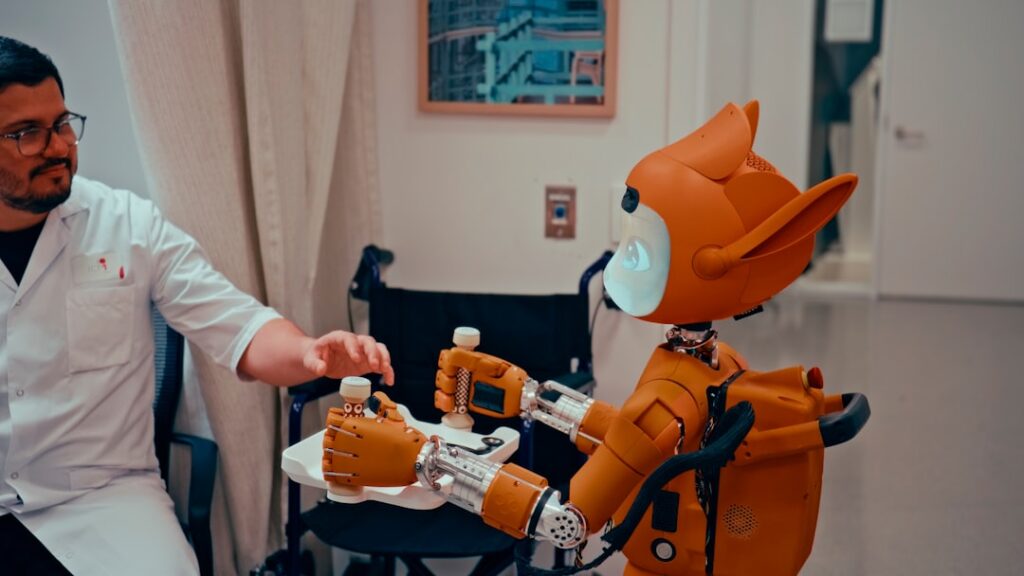
AI’s impact won’t be uniform across industries. Some sectors will experience near-complete workflow transformation. Others will see augmentation more than automation. Understanding which category applies to your field is the most practical thing you can do right now.
Healthcare: From Diagnostic Aid to Preventive Medicine
AI is already demonstrating strong diagnostic performance in areas like screening for diabetic retinopathy and analyzing speech patterns to predict neurological diseases. AI will initially serve as a diagnostic aid rather than replacing physicians outright — but the ongoing interaction between clinicians and AI systems will improve accuracy over time, eventually building enough confidence for humans to delegate tasks more fully.
AI-driven prediction and intervention means are expected to enable more than 80% of chronic diseases to be effectively prevented by 2035, significantly extending people’s healthy lifespan. That’s not a certainty — it’s a projection with wide confidence intervals — but the directional movement toward AI-powered preventive healthcare is unmistakable.
Finance: Algorithmic Decisions at Scale
The finance sector represents perhaps the most natural fit for AI implementation given its inherently data-intensive nature. By 2030, approximately 90% of all trading decisions will incorporate AI-driven insights and execution. For consumers, this means faster credit decisions, more personalized financial products, and — if governance fails — riskier concentrations of automated decision-making power.
Manufacturing: The $2.3 Trillion Opportunity
AI is expected to generate additional global economic activity of around $13 trillion by 2030 — approximately 16% higher cumulative GDP compared to today. Within this broader impact, manufacturing stands to gain a staggering $2.3 trillion in economic value. On factory floors, AI implementation focuses on automating repetitive tasks like data entry and order processing, while predictive maintenance, process automation, and supply chain optimization further streamline operations.
Knowledge Work and Content Creation
This is the category most relevant to WordPress site owners, bloggers, and solopreneurs. The honest assessment: AI is already a powerful accelerant for content creation, coding, and research — but it amplifies your judgment, not replaces it.
Research from Erik Brynjolfsson’s Stanford Digital Economy Lab already shows 14–15% productivity gains for customer support workers using AI assistants, with novice workers improving by 34%. The gains are real, measurable, and skewed toward those who learn to use AI effectively — which is itself a skill gap most organizations haven’t closed. While 89% of respondents in a 2024 BCG study said their workforce needs improved AI skills, only 6% said they had begun upskilling in “a meaningful way.”
The Job Market: Net Positive but Bumpy
According to the World Economic Forum, AI will create 170 million new jobs while displacing 92 million by 2030 — a net creation of 78 million positions. However, the transition requires massive reskilling efforts, as workers with AI skills command a 43% wage premium.
The trade-off: the net job creation number is encouraging, but the transition is uneven. People in the two lowest wage quintiles are up to 14 times more likely to need to change occupations by the end of this decade than the highest earners. New positions will likely center on “human-plus” capabilities: AI ethics officers, human-AI collaboration designers, and specialized roles in physical AI such as robotics and autonomous mobility. Those are real jobs — but they require very different skills than the jobs being displaced.
If you’re experiencing anxiety about what AI means for your work, that’s a rational response — not overcaution. The right move is to start building AI fluency now, before the skills gap becomes a career gap.
Challenges and Ethical Considerations
Future AI’s potential is enormous. So are its risks. Here’s what most optimistic forecasts gloss over — and why these challenges should shape how you adopt and evaluate AI tools today.
Hallucinations: A Feature, Not Just a Bug
Hallucination is commonly used to describe instances where an artificial intelligence system generates false, misleading, or fabricated information that diverges from the original source content. Generative models are often found to produce hallucinated content — outputs that sound fluent but contain incorrect or misleading information. These hallucinations are especially likely when the input is ambiguous and become more serious in sensitive fields such as medicine or law.
The honest limitation: even as models improve, the gap between confident-sounding output and factually grounded output remains a fundamental challenge. Any professional using AI in high-stakes contexts — legal, medical, financial — needs human verification built into every workflow, not as an afterthought.
Algorithmic Bias: A Societal Problem, Not Just a Technical One
AI systems are increasingly embedded in high-stakes decision-making across domains such as healthcare, finance, criminal justice, and employment — and evidence has accumulated showing that these systems can reproduce and amplify structural inequities.
Bias in AI is not merely a technical issue but a societal challenge — addressing it is not only about improving technology but about fostering ethical responsibility and social justice. The critical gotcha to watch for: AI systems trained on historical data inherit historical biases. If your company uses AI for hiring, lending, or customer scoring, bias audits aren’t optional — they’re a legal and reputational necessity.
The Energy Problem: AI’s Growing Carbon Footprint
With data centers projected to consume 10% of U.S. power by 2030, space-based AI facilities and alternative energy sources are being explored, though development timelines extend into the 2040s due to regulatory and technical challenges. This is an underreported constraint on AI’s growth trajectory. Compute scaling is real — but so is the infrastructure required to power it.
Regulatory Fragmentation: A Global Race With No Referee
Across the globe, policymakers demonstrate significant interest in responsible AI. In 2024, global cooperation on AI governance intensified, with major organizations — including the OECD, European Union, United Nations, and African Union — publishing frameworks to articulate key concerns such as transparency, explainability, and trustworthiness.
The trade-off here: more governance is necessary, but fragmented governance creates compliance burdens for businesses operating across multiple jurisdictions. Always check renewal pricing, data residency requirements, and compliance status of any AI tool before committing — especially if you serve EU customers.
The AGI Uncertainty: When Expert Forecasts Span Decades
The forecast weighted by expert tier suggests a median arrival time for transformative AI around 2035–2040, with approximately 25–35% probability by 2030 and meaningful probability mass extending to 2050 or beyond. The central tension dividing experts is not optimism versus pessimism — it’s the question of whether current AI architectures can scale to human-level intelligence or require fundamental breakthroughs. This disagreement produces forecast uncertainties spanning decades.
What this means practically: plan for AI capability improvements on a 2–3 year horizon with high confidence, and treat anything beyond that as scenario planning rather than certain forecast. Decisions you make about AI adoption in 2025 should be reversible enough to adapt as the landscape shifts.
Preparing for an AI-Driven Future

You don’t need to predict the exact shape of AGI to make smart decisions about AI today. What you need is a phased approach that builds resilience without betting the house on a single technology forecast.
If you’re experiencing decision paralysis about where to start with AI, here’s a practical framework:
Phase 1: Build AI Literacy (Start Now)
Employers expect 39% of workers’ core skills to change by 2030. Technology skills such as AI and big data, networks, and cybersecurity are showing the largest net increase in the share of respondents identifying them as critical for the next five years. Start by using AI tools daily on low-stakes tasks — drafting emails, summarizing documents, generating first-draft content — before scaling to mission-critical workflows.
Human skills such as communication, attention to detail, and leadership remain in high demand among employers. These skills complement AI’s capabilities and are transferable across roles and industries — because while AI excels at data processing, it falls short in areas like judgment, intuition, and cultural awareness. Investing in those uniquely human skills isn’t a hedge against AI — it’s a strategy that compounds in value as AI capabilities expand.
Phase 2: Identify Your Highest-Value AI Use Cases (Months 1–3)
A tool needs to save at least twice its monthly cost in time to justify the expense. Map your current workflows and identify where AI can accelerate research, content production, customer response, or technical work. Test one tool at a time — not five simultaneously — on real tasks for 30 days before committing.
Anthropic’s January 2026 Economic Index found that 52% of Claude conversations were classified as augmentation — helping humans do their jobs better — compared with 45% categorized as automation, with augmentation especially prevalent in complex, knowledge-intensive tasks. This tells you something important: the current highest return on AI investment is amplification, not replacement. Start there.
Phase 3: Scale and Systematize (Ongoing)
In an AI-intensive enterprise, transformation must begin with a clear view of how an organization can evolve — not just what tools to deploy. Leaders must understand what capabilities drive differentiation, how roles will change as AI becomes embedded in everyday work, and how new learning pathways can help employees move toward higher-value problem-solving.
Done is better than perfect here. Organizations that wait for the “right” AI strategy often miss the compounding productivity gains available to early adopters. Companies that move first in AI adoption could pull dramatically ahead of competitors — early movers may potentially double their cash flow, achieving additional annual net cash-flow growth of about 6% for more than a decade.
At WordPress AI Tools, we track these developments specifically through the lens of what matters for site owners, content creators, and small business operators — because the future of AI isn’t abstract. It’s showing up in your writing tools, your SEO stack, your customer service workflows, and your hosting decisions right now.
If you need guidance on which AI tools to adopt first, how to evaluate them without wasting budget, or how to build AI into your WordPress workflow in a way that actually delivers ROI, our team is here to help. Contact WordPress AI Tools today for personalized guidance tailored to your situation — no pressure, no generic advice.
Frequently Asked Questions
Stay Informed About AI’s Evolution
The landscape of future AI will shift faster than any single guide can keep pace with. The most important thing you can do right now is not pick the “perfect” tool or nail down a decade-long AI strategy — it’s to build the habit of staying informed, experimenting intentionally, and maintaining enough flexibility to adapt when the landscape shifts (and it will).
Start with one AI tool that addresses your most painful current workflow bottleneck. Test it for 30 days. Measure the actual time and quality impact. Then scale only when you see clear, measurable results. That’s a more sustainable path than chasing every breakthrough announcement.
At WordPress AI Tools, we publish in-depth, honest reviews and practical guides for WordPress users and small business owners navigating the AI landscape — without the affiliate hype or overclaiming. Explore our tool reviews and guides to find what fits your actual needs and budget. And if you’re at a decision point — whether to adopt AI for content, SEO, hosting, or customer service — contact WordPress AI Tools today to get personalized guidance with no pressure and no generic recommendations.
Frequently Asked Questions
When will AGI (Artificial General Intelligence) arrive?
Expert predictions vary widely. CEOs of OpenAI, Google DeepMind, and Anthropic predict AGI within 5 years. A weighted forecast across AI researchers suggests a median arrival around 2035–2040, with a 25–35% probability by 2030. The honest answer: deep expert disagreement persists because it depends on whether current architectures can scale to human-level intelligence or whether new breakthroughs are required.
Will AI take my job?
AI will transform most jobs, but outright replacement is less likely than significant restructuring. The World Economic Forum projects AI will displace 92 million jobs while creating 170 million new ones by 2030 — a net positive, but with a difficult transition for workers in lower-wage roles. Building AI literacy now significantly improves your position regardless of which scenario plays out.
What AI skills should I start building now?
Prioritize AI literacy (learning to use generative AI tools for your specific workflow), prompt engineering, and data interpretation. Just as important are human skills AI can’t replicate: critical thinking, communication, contextual judgment, and creative problem-solving. Employers consistently rank these as the most durable competitive advantages in an AI-augmented workplace.
Is it safe to use AI for business decisions?
AI is a powerful decision-support tool, but it should augment, not replace, human judgment in high-stakes decisions. Current AI systems can hallucinate (produce confident but false outputs), carry algorithmic biases, and lack contextual awareness in complex situations. For hiring, financial, legal, or medical decisions, always build human review into the workflow.
How will future AI affect small businesses and content creators?
Future AI will be a powerful productivity multiplier for small businesses and content creators — accelerating research, content production, customer service, and SEO workflows. Early adopters are already seeing 15–35% productivity gains. The critical gotcha: AI accelerates your output but doesn’t replace your strategic thinking, brand voice, or audience relationships. Use it as a tool, not a substitute for editorial judgment.

